EasyIncubate
How I Track Multiple Hatches Without Losing My Mind
Once hatch work gets serious, memory and scattered notes stop holding up. Here is the simple system I wish I had started with sooner.
Quick answer: Once you have more than one batch going, you need one clear record per batch and the important days visible without relying on memory.
If you are hatching enough birds that your notebook is starting to look like a crime scene, you are not alone. I hit that point with pheasants and chickens and realized pretty quickly that memory, scattered notes, and "I'll write that down later" was not a real system. The short version is this: once hatch work gets serious, you need one clear record per batch or things start getting fuzzy fast.
Now, as always, there is a little more to it than that.
What actually breaks first?
At first, I thought the main problem was remembering when eggs were set.
That was part of it, sure. But the bigger issue was everything else that starts piling up once you have enough going on:
- set dates
- candling results
- lockdown timing
- hatch numbers
- losses
- odd incubator notes
- humidity swings
- cabinet changes
- the things you are absolutely certain you will remember later
If you are anything like me, that last one is where things start to go off the rails.
The more batches I had going, the more important details were living in my head instead of in a system I could actually trust.
Why loose records get expensive
The annoying part is not just feeling disorganized.
The expensive part is when a hatch does not go the way you hoped and you are left trying to reconstruct what happened after the fact.
Was humidity off longer than I thought?
Did I candle later than usual?
Did I move a batch and forget to write it down?
Did this cabinet have the issue, or was that the other one?
That is the kind of thing that can cost real money. It is also the kind of thing that makes you want to kick yourself because you know the information was available at one point. It just was not anywhere useful.
The system I actually needed
I did not need a giant farm management platform.
I did not need one more beat-up notebook.
And I definitely did not need a bunch of complicated charts I was going to ignore the second hatch season got busy.
What I needed was something simple enough to use during real hatch work and structured enough to still help me later.
For me, that came down to four things.
1. One clear record per batch
Every batch needs its own story in one place.
Not half on the eggs, half in your head, and half in some notebook that has wandered off to another building.
I want to open a batch and see:
- when it was set
- when I candled
- what changed
- what hatched
- what did not
That is the baseline.
2. Important days need to stay obvious
Candling. Lockdown. Expected hatch.
Those are not hard to remember when you have one thing going on.
They get a whole lot harder to keep straight once you have multiple batches moving at once, especially when normal life is happening around the incubator too. Which, last time I checked, it usually is.
A good system should not make me work harder to remember the important days. It should keep them obvious.
3. Notes have to be easy to add in the moment
If a system depends on me sitting down later and writing a perfect summary, that system is eventually going to fail.
I need to be able to jot down the useful bits while they are fresh:
- quick candling notes
- weird humidity swings
- movement between cabinets or shelves
- hatch counts
- anything future-me is going to wish present-me had bothered to write down
That last category is bigger than I would like to admit.
4. The record has to help later
A lot of tracking systems are really just storage.
That is not enough.
I want something that helps me answer questions later, especially when a hatch underperforms and I need more than a shrug and a vague memory.
That is the whole point. Not collecting data for the sake of it. Keeping a record that is actually useful when you need it.
What I recommend tracking at a minimum
If you are trying to keep things under control without turning hatch day into an accounting exercise, this is the minimum I would want for each batch:
- Set date
- Species or breed
- Egg count
- Location
- Placement details if useful
- Candling results
- Lockdown date
- Hatch totals
- Quick notes when something changes
That is enough to give you a useful record without drowning you in admin work.
Why I ended up building EasyIncubate
I built EasyIncubate because I hit the point where my old system stopped holding up.
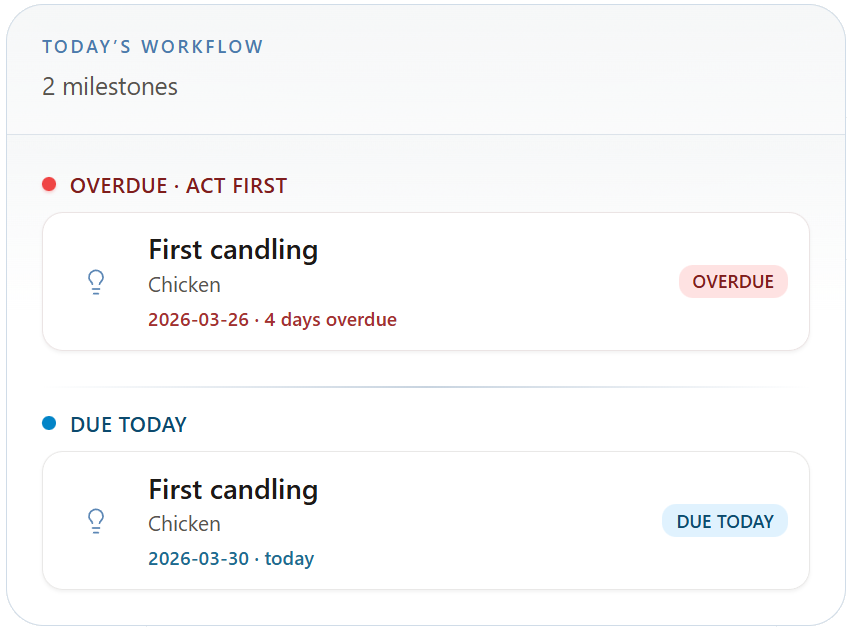
I wanted clear milestones. A Today view that told me what actually mattered. A running record for each batch. And a way to carry things forward after hatch instead of losing the thread the second the eggs popped.
In other words, I wanted something better than memory and optimism.
That is what EasyIncubate is built around.
If you want the same handoff after hatch, how hatch records should carry into inventory is the companion piece to this one.
If your current system is working, keep going
Honestly, if your current system is working and you trust it, I am not here to tell you to throw it out and replace it with an app.
But if you are starting to feel the cracks, if important details are getting fuzzy, or if you have ever found yourself trying to reconstruct a bad hatch from scraps, then you are probably at the same point I was.
And that is usually the point where a tighter system starts paying for itself.
To conclude
Tracking hatches does not have to mean more busywork.
The goal is not to create one more chore. The goal is to make the important stuff easier to see now and easier to understand later.
That is what I was after when I built EasyIncubate, and it is still the standard I keep coming back to when I think about what this tool should be.
If you want a cleaner way to track batches, milestones, hatch outcomes, and notes, start your trial and see if EasyIncubate fits the way you work.